
By Rhea Arora
For many consumer markets, the COVID-19 pandemic triggered a major pendulum swing to the virtual world that is now trending back to analogue, driven largely by a collective desire to “touch grass.” India’s faith economy, however, is following a different script. Like the rest of the world, Indians logged into Zoom and Facebook Live for darshans and aartis but never logged out. The country’s spiritual industry — long anchored in temple visits and pilgrimages — is becoming increasingly digitised, and this online infrastructure is holding its own despite the larger cultural tide pulling consumers back to in-person experiences.
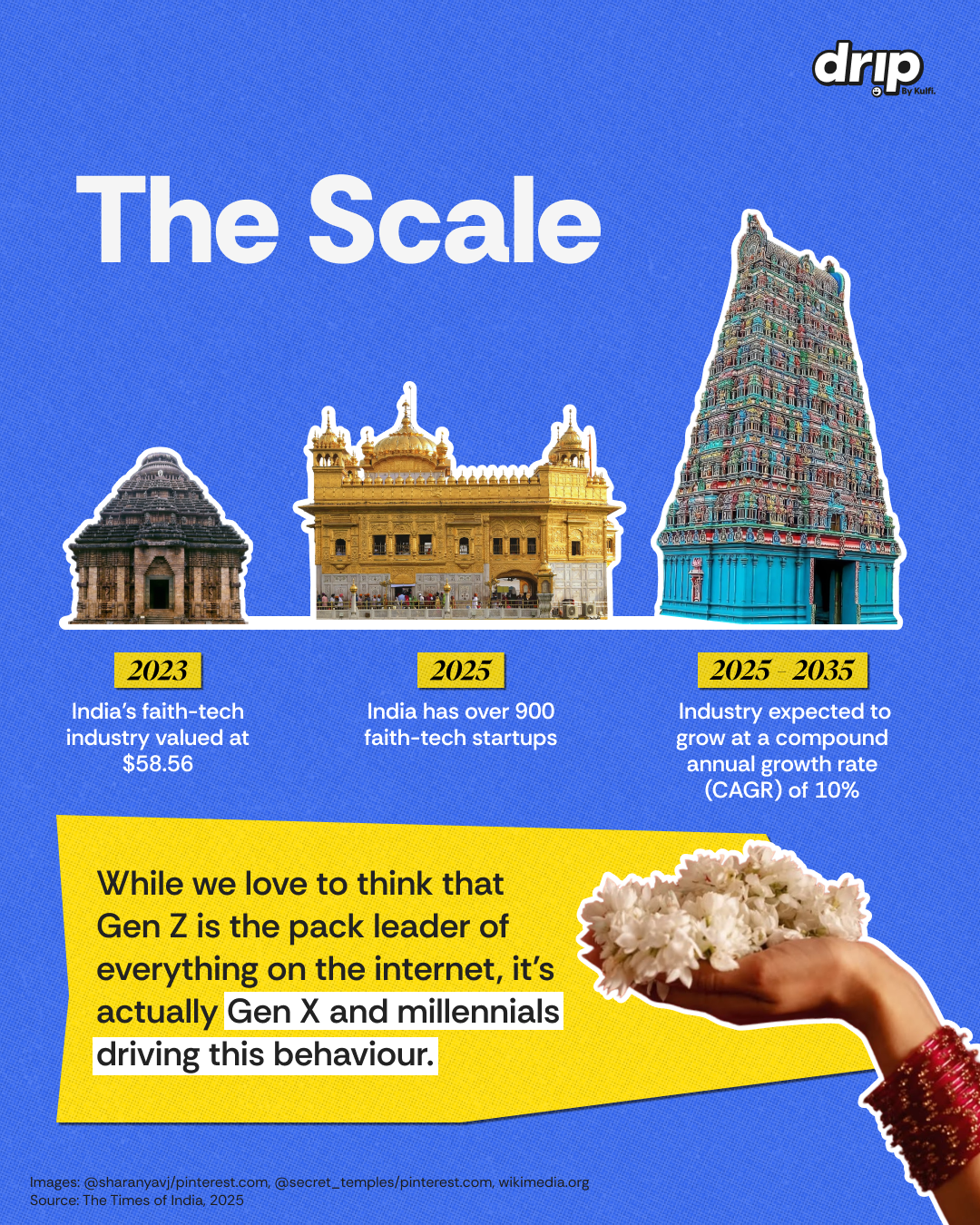
As of 2025, India has over 900 faith-tech startups, part of an industry that was valued at $58.56 billion in 2023 and is expected to grow at a compound annual growth rate (CAGR) of 10% for the next 10 years. But while Gen Z might be the pack leader of several things online, Gen X and millennials are the cohorts driving this trend.
HOW FAITH-TECH START-UPS WORK
“We’re a digital spiritual marketplace covering 360-degree needs of Indian consumers,” says Ankita De, co-founder and CMO of Utsav, one of India’s most popular spiritual platforms that also raised ₹6.35 crore in a Pre-Series A funding last year. Utsav offers everything from daily puja needs to livestreamed rituals, auspicious calendars, Vedic astrological readings, and doorstep delivery of consecrated prasad, bracelets and prayer books. Most of its customers are IT professionals, bankers, businesspersons, and government workers between the ages of 30 and 50 living in metro cities like Mumbai, Bangalore, Delhi and Kolkata. “They feel guilty about not being able to visit temples. The convenience factor is another behavioural change that’s contributed to the growth of online puja platforms — people want everything at home,” says De.
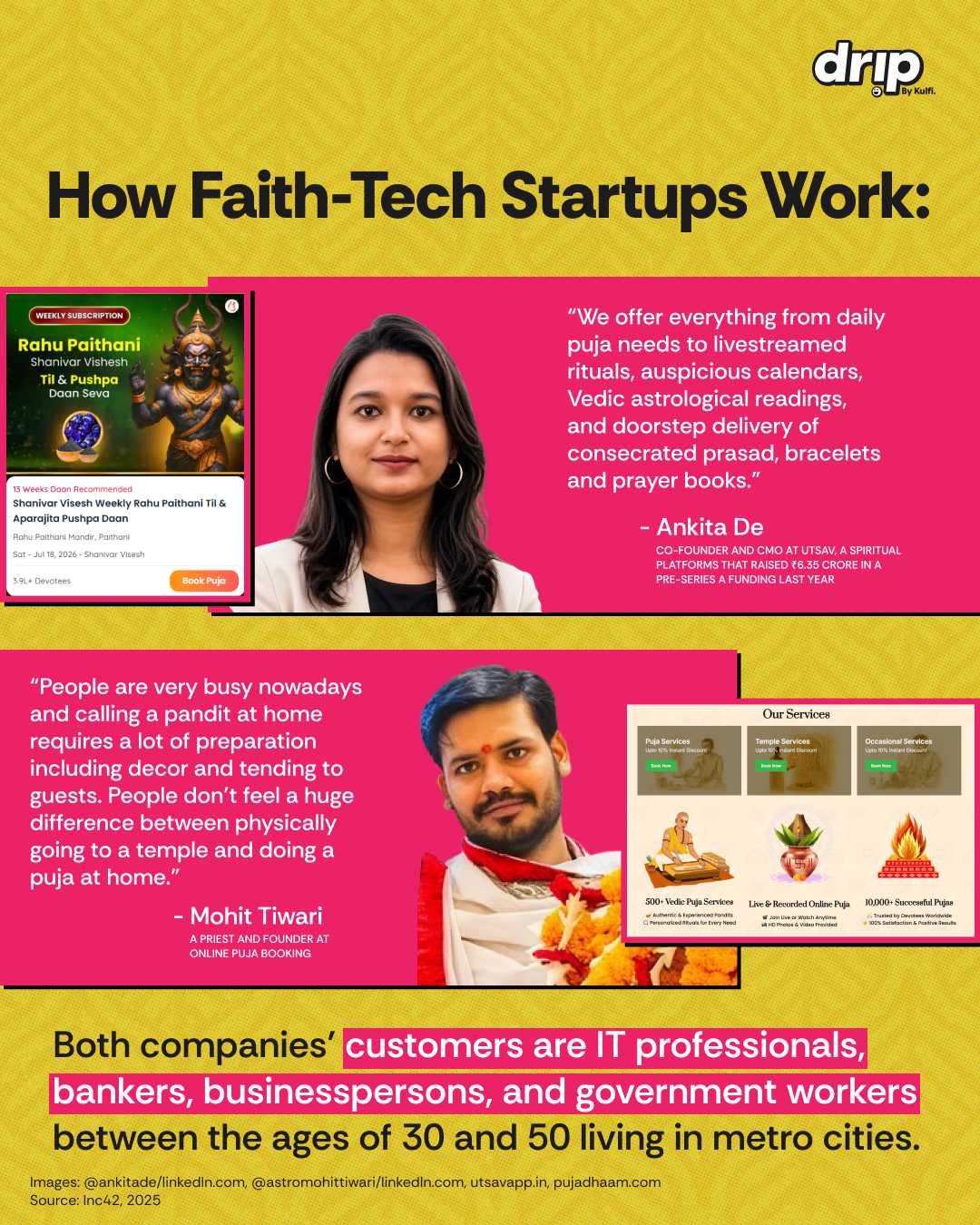
Mohit Tiwari, a priest and founder of Online Puja Booking, agrees, adding that virtual pujas have only skyrocketed since the pandemic. His platform offers on-demand live pujas on Zoom and YouTube and personalised sankalp (incantations), and is most frequented by a cohort identical to Utsav’s. “People are very busy nowadays and calling a pandit at home requires a lot of preparation including decor and tending to guests,” he says. “Online pujas have almost become normalised. People don’t feel a huge difference between physically going to a temple and doing a puja at home.”
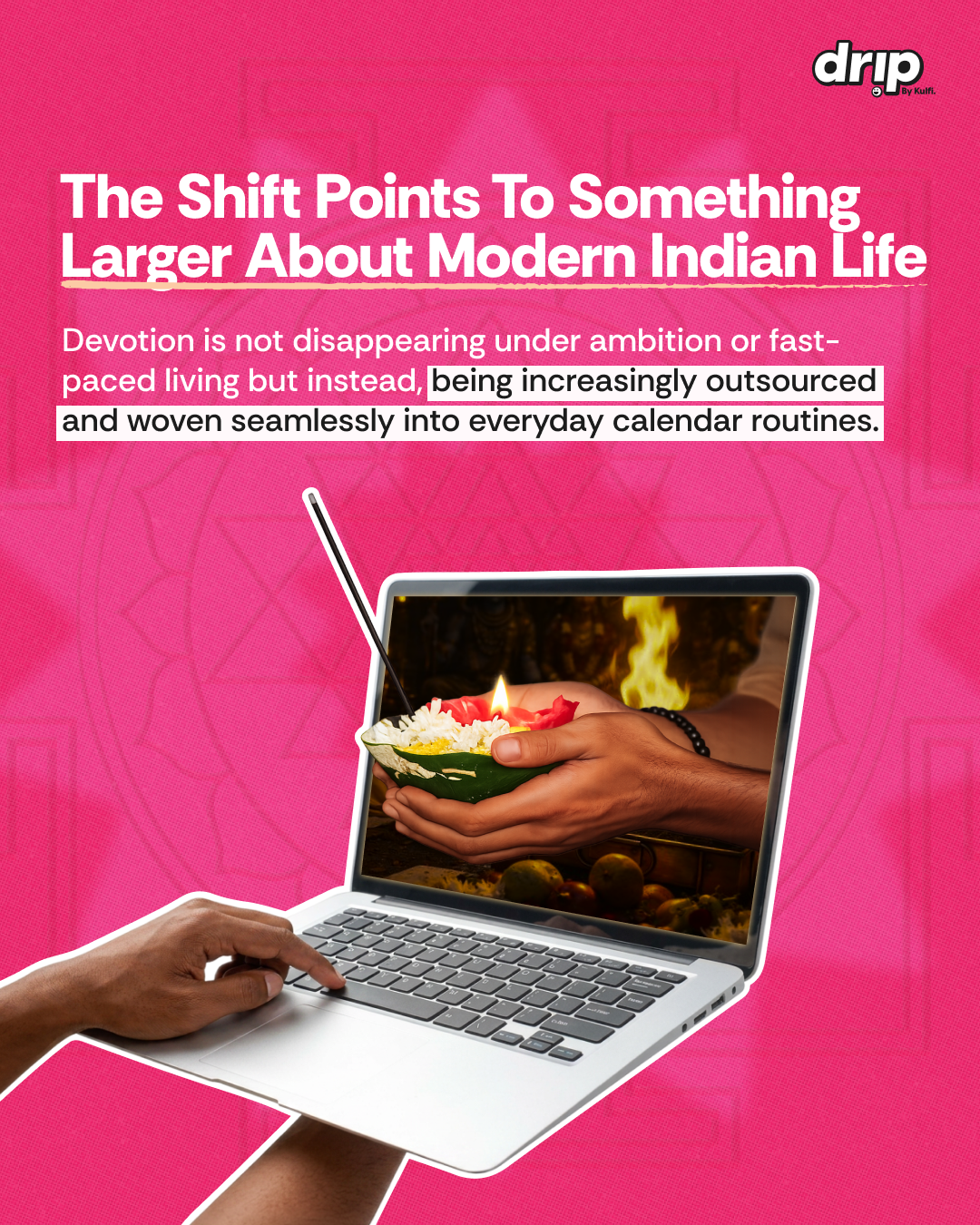
The shift points to something larger about modern Indian life: devotion is not disappearing under ambition or fast-paced living but instead, being increasingly outsourced, delegated, and woven seamlessly into everyday routines.
The most important factor, Tiwari says, is legitimacy. The more trust a customer places in the pandit, the more they trust the platform itself.Tiwari’s most popular offering is a Rudrabhishek Puja dedicated to Lord Shiva for ₹3,499, and his busiest month is July or Shravan when people seek pujas conducted in temples in pilgrimage towns like Bithoor in Kanpur.
Utsav, meanwhile, earns half its revenue through subscriptions. “We didn’t build Utsav as a daily use case. But there’s a good cohort of people who use it daily and weekly,” says De, noting that customers sometimes don’t even watch the online puja they’ve paid for. “We tried drawing parallels with OTT platforms where watch time determine usability. But we realised that once customers trust us, they consider this more like an insurance payment.” she says. In a digital economy obsessed with engagement metrics and measurable outcomes and despite being part of an industry vulnerable to scams, faith-tech may be one of the few categories where trust matters more than proof of efficacy.
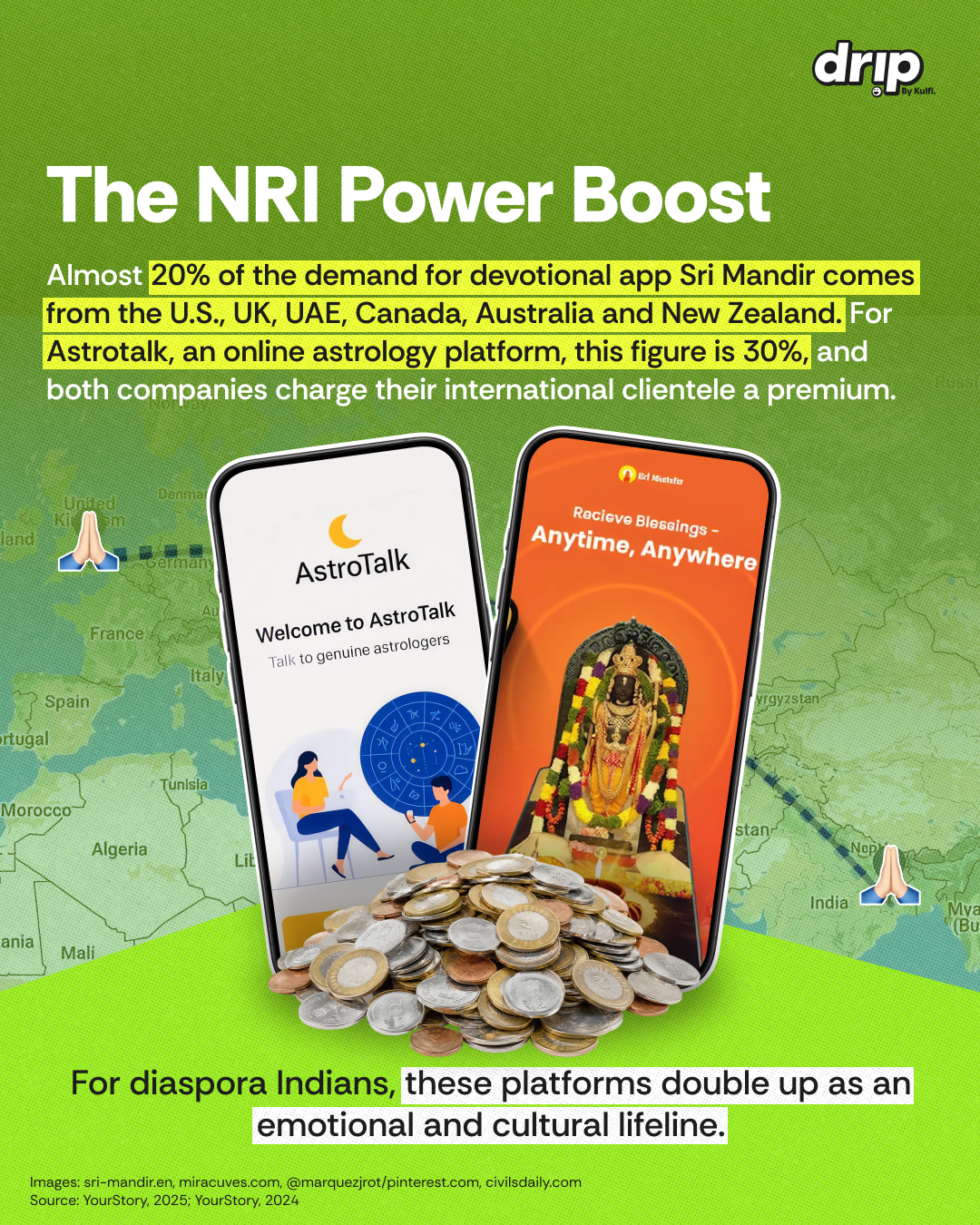
Other popular apps like Astrotalk and Sri Mandir are scaling with millions of venture-capitalist dollars. They are focusing on another lucrative cohort: diaspora Indians. Almost 20% of Sri Mandir’s demand comes from the U.S., UK, UAE, Canada, Australia and New Zealand. For Astrotalk, this figure is 30%, and both companies charge their international clientele a premium. For diaspora Indians, these platforms seem to function more as emotional and sentimental continuity by being a way to maintain rituals, identities and connections across distance.
Temples themselves are players in India’s spiritual ecosystem too. From livestreamed ceremonies to subscription-based pujas, temple trusts and boards are recognising the value of digital distribution. “A lot of temples have their own websites and apps but don’t provide a great user experience,” says De. “There’s no customer service or backend tech support. We come in as a plug and play solution.”
THE COMPATIBILITY OF HINDUISM AND THE ON-DEMAND ECONOMY
Unlike the more centralised worship structures of Christianity or Islam, Hinduism is more situational and choice-driven, making it particularly compatible with an on-demand economy. De says that Indians customise their worship based on three key factors: the perceived auspiciousness of a location, mythological narratives they resonate with, and a belief in astrology.
In fact, 79% believe that nature carries spiritual energy, and Hindu scriptures reinforce this by mentioning sites believed to exist today like the Shakti Peethas (Goddess temples), 12 Jyotirlingas (Shiv temples), and Char Dham pilgrimage points. They also feature deities whose stories mirror human struggle and aspiration, giving worshippers a personal reason to seek out specific rituals dedicated to a specific god at a specific temple. That translates neatly into platform behaviour. Beyond pujas for health, finances, career, and marriage, platforms offer rituals or visas and overseas travel that range from ₹2,000 to ₹16,000.
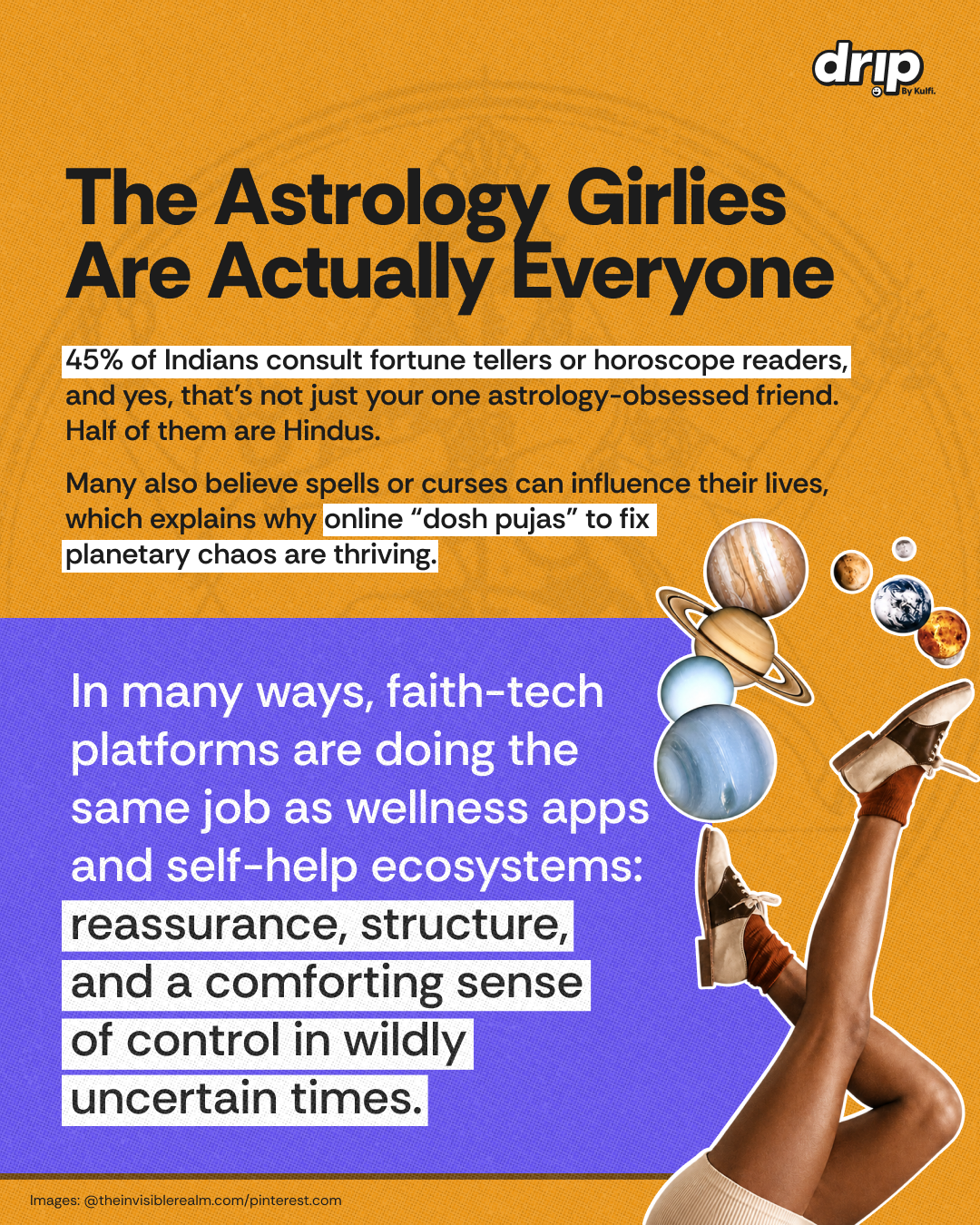
Astrological beliefs have a strong foothold on the subcontinent too as 45% of Indians consult fortune tellers or horoscope readers, half of which are Hindus alone. Indians also believe spells or curses can influence their lives, explaining the popularity of online “dosh pujas” designed to remove astrological obstacles and malicious planetary influence. This way, faith-tech platforms are increasingly serving the same needs that wellness apps, self-help ecosystems and therapy platforms do: reassurance, clarity, routine and a sense of control in wildly uncertain times.
MAKING RELIGION COOL AGAIN?
For many young Indians, religion exists comfortably alongside astrology apps, trending audio and the internet’s language of virality. “Gen Z is not moving away from traditional culture — they’re doing it differently. They like bending rules with bhajan clubbing and memes,” says De. There’s also been an explosion in religious content creation, spurring creators like Bhavesh Bhimanathani, Mahima Mor, Hitesh Mahawar, and Parveen Sharma who have hundreds of thousands of followers. Even non-creators outside this niche post content flexing their religious identity with trending audio and formats that often go viral. “The Hindutva ecosystem has worked, assiduously, to make religion ‘cool’ for the younger generations,” says Kunal Purohit, author of H-Pop: The Secretive World of Hindutva Popstars. “As a result, for at least some young Indians, their understanding of religion comes from an ecosystem that has deliberately equated religion with nationalism.”
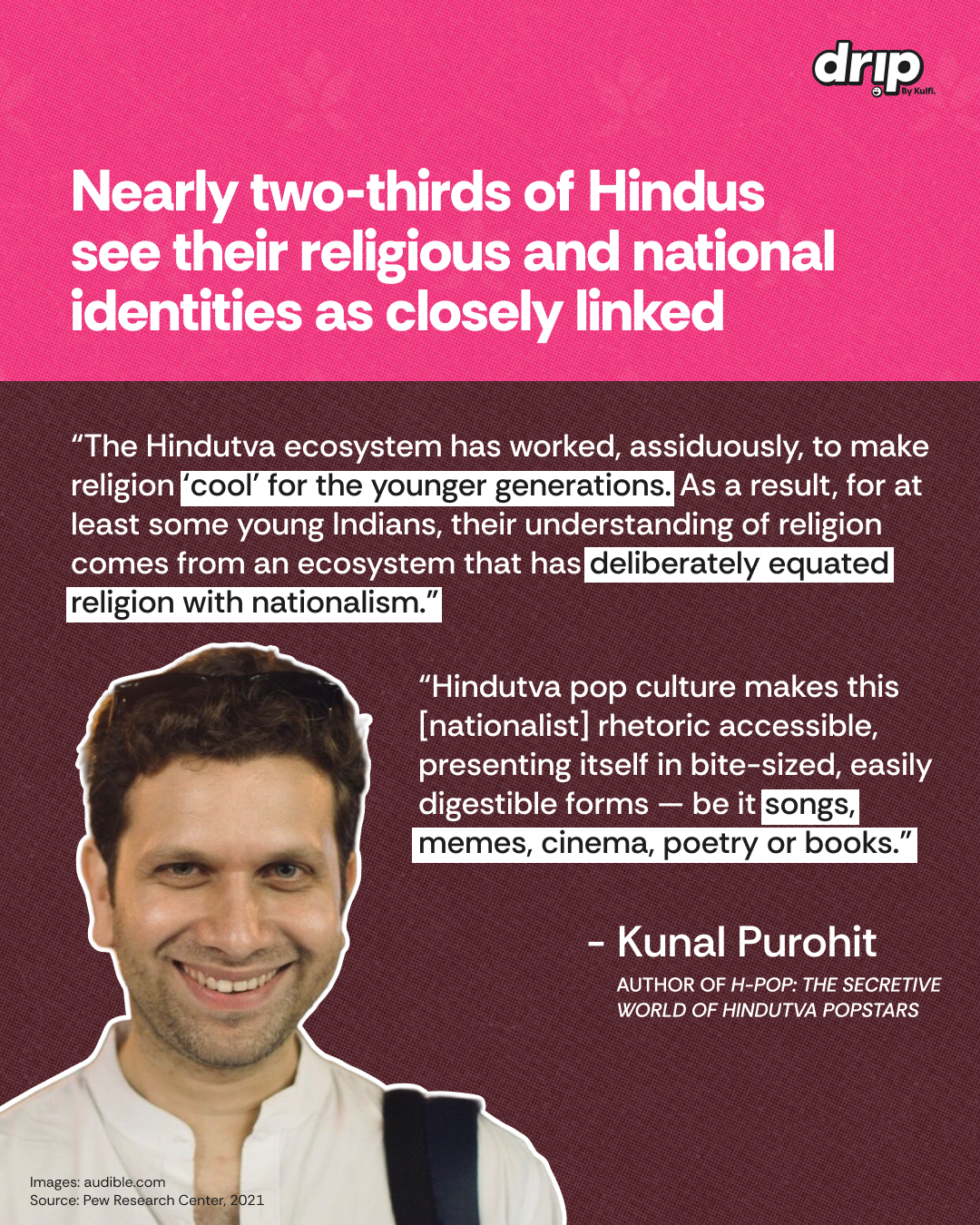
Research supports his view: nearly two-thirds of Hindus see their religious and national identities as closely linked. “Hindutva pop culture makes this [nationalist] rhetoric accessible, presenting itself in bite-sized, easily digestible forms — be it songs, memes, cinema, poetry and books,” says Purohit. Over the past few years, Hinduism has become ubiquitous in mainstream Indian pop culture: celebrities like Sara Ali Khan, Virat Kohli, and Janhvi Kapoor are often photographed at religious sites. Astrotalk also courted endorsements from Mandira Bedi, Ranbir Kapoor, and Shraddha Kapoor and bought ad placements during the Indian Premier League, one of India’s largest sporting events.
During the 2025 Maha Kumbh Mela, even big brands like Amazon, Coca-Cola, and Dettol showed up with activations. “Religiosity has been incentivised: from the nation’s leadership going to temples constantly to brands participating in this to start-ups pitching in means the user feels a sense of validation while participating in a religious event. All this is pushing religion deeper into the lives of ordinary Hindus,” explains Purohit. The result is not necessarily a return to old forms of religiosity, but the emergence of newer, more visible, digitally mediated ones.
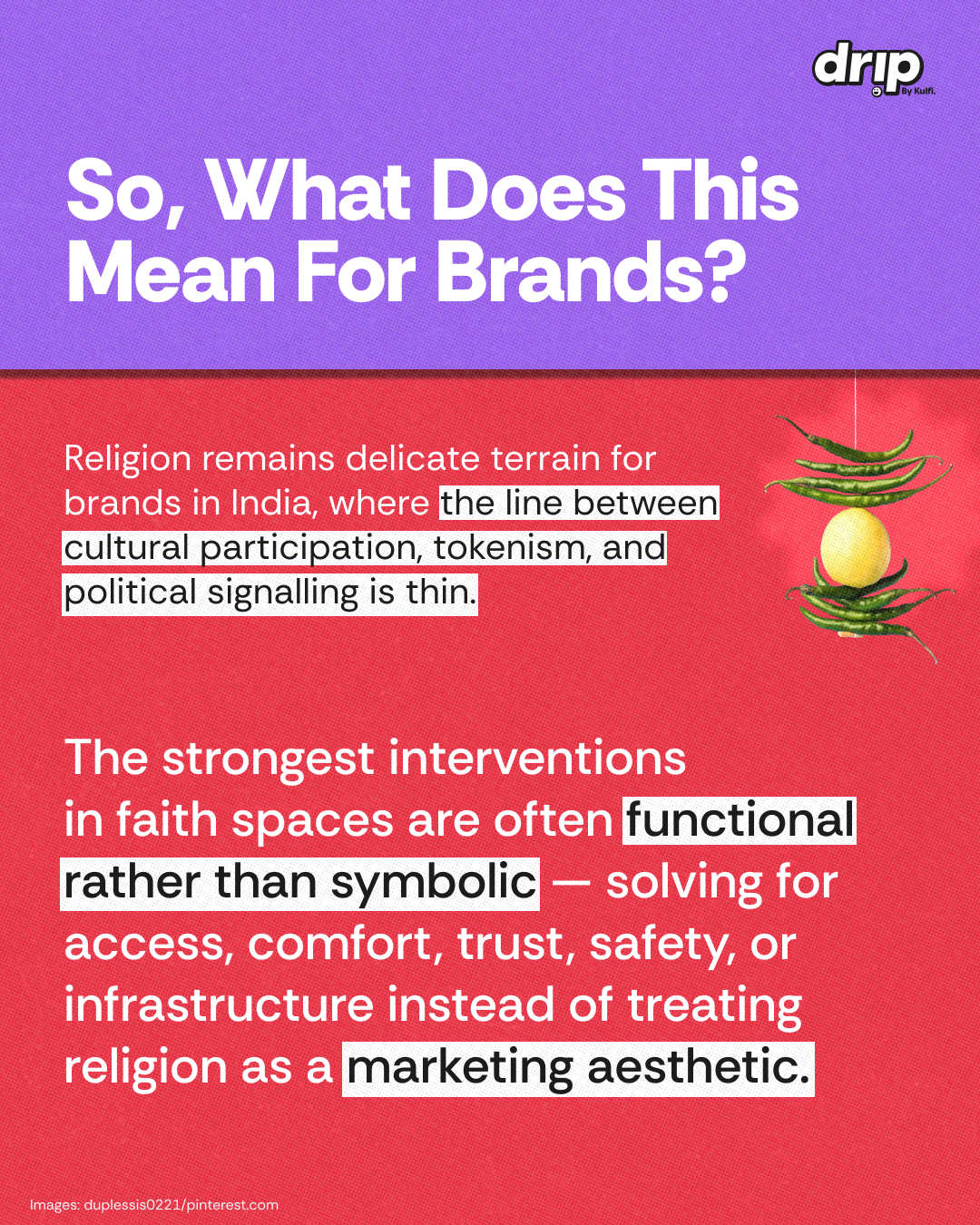
Religion, however, remains delicate terrain for brands in India, where the line between cultural participation, tokenism, and political signalling is thin. Consumers are increasingly savvy at spotting opportunistic engagement too. That’s why the strongest interventions in faith spaces are often functional rather than symbolic — solving for access, comfort, trust, safety, or infrastructure instead of treating religion as a marketing aesthetic.
AN EXTENSION OF RELIGIOUS TOURISM
Despite its sprawling digital infrastructure, faith-tech’s biggest growth opportunity may lie offline.
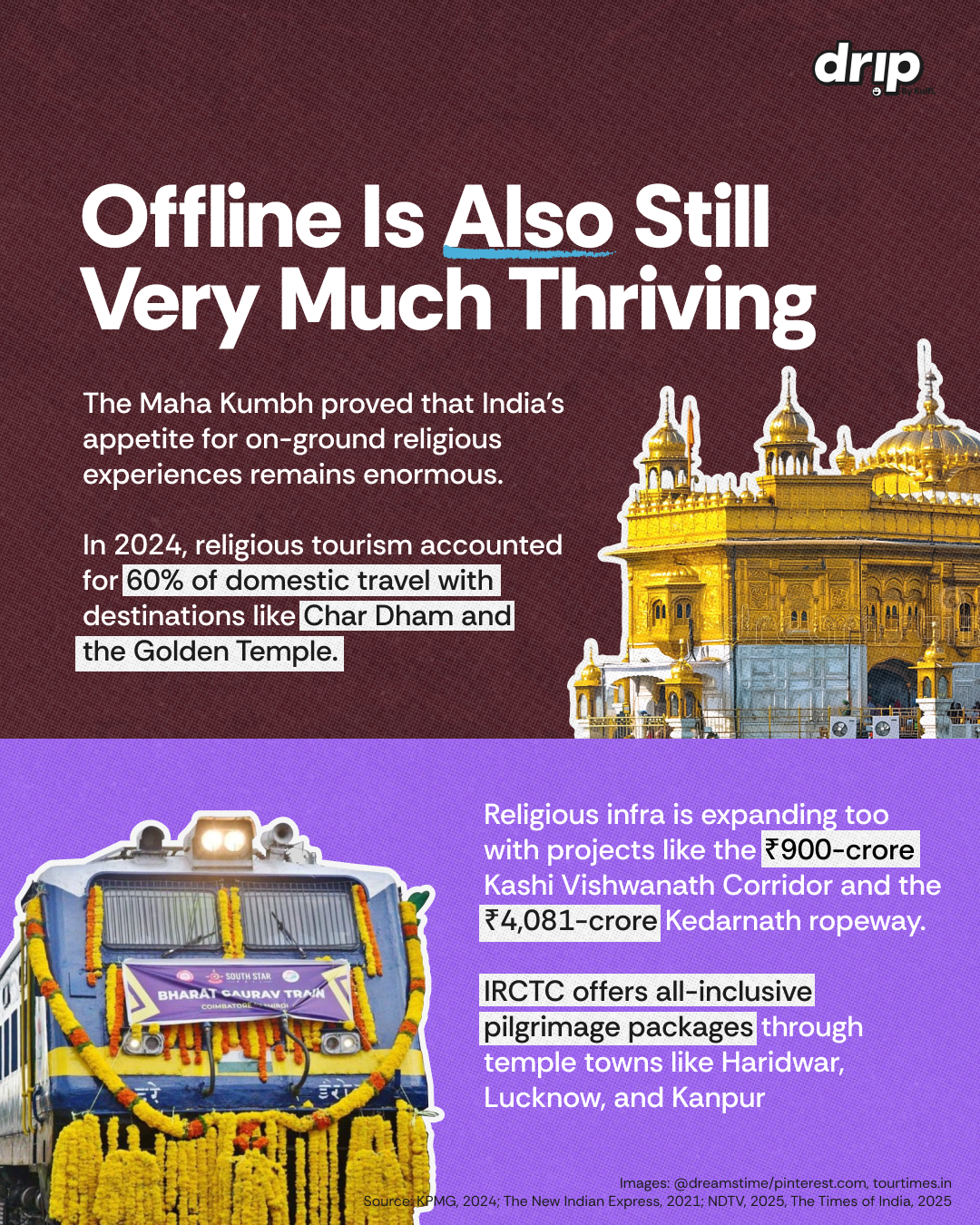
In 2024, religious tourism accounted for 60% of domestic travel in India with destinations like Char Dham, Vaishno Devi, and the Golden Temple getting massive footfall. The government has invested heavily in infrastructure projects such as the ₹900-crore Kashi Vishwanath Corridor in Varanasi and the ₹4,081-crore Kedarnath ropeway.
The Indian Railway Catering and Tourism Corporation (IRCTC) offers all-inclusive pilgrimage packages through temple towns like Haridwar, Lucknow, and Kanpur that approximately range from ₹24,000 to ₹55,000. With their popularity among diaspora Indians, Astrotalk and Sri Mandir are primed for this — could they collaborate with Cleartrip or MakeMyTrip or even Airbnb on a “return to roots” travel package? Duolingo could be roped in for regional language phrasebooks or Google for live translation tools. Utsav’s existing calendar feature could also redirect customers to travel packages for auspicious days.
But the more interesting opportunities may lie in solving the logistical realities around pilgrimage itself. “Travel itself is not a problem — you can get to the temple doorstep conveniently,” says Tiwari. ”But there could be more places to rest along the way.”. The 2025 Maha Kumbh Mela in Prayagraj is a strong model for this: Coca-Cola equipped sanitation workers and boatmen with PET lifejackets, Eveready Lighting installed street lights, and Vi (Vodafone Idea) distributed ‘Number Rakshak’ bracelets carrying emergency contact details for pilgrims. Similarly, boAt could partner with Tata Power to set up solar phone charging stations along trekking routes.
There’s also room for unexpected categories to enter the ecosystem. Ayurvedic beauty brands like Himalaya could build portable hygiene stations with grab-and-go toiletry kits. Fast&Up could set up hydration stations or Urban Naps could install rest and sleep pods. Financial services could also step into this ecosystem through family contribution pools for pilgrimages or instalment-based travel packages. Imagine wearable-tech companies creating haptic navigation bands for pilgrims in crowded yatras or mapping platforms introducing crowd-density alerts and rest-stop recommendations.
CONNECTING WITH SMALL TOWNS AND URBAN GEN Z
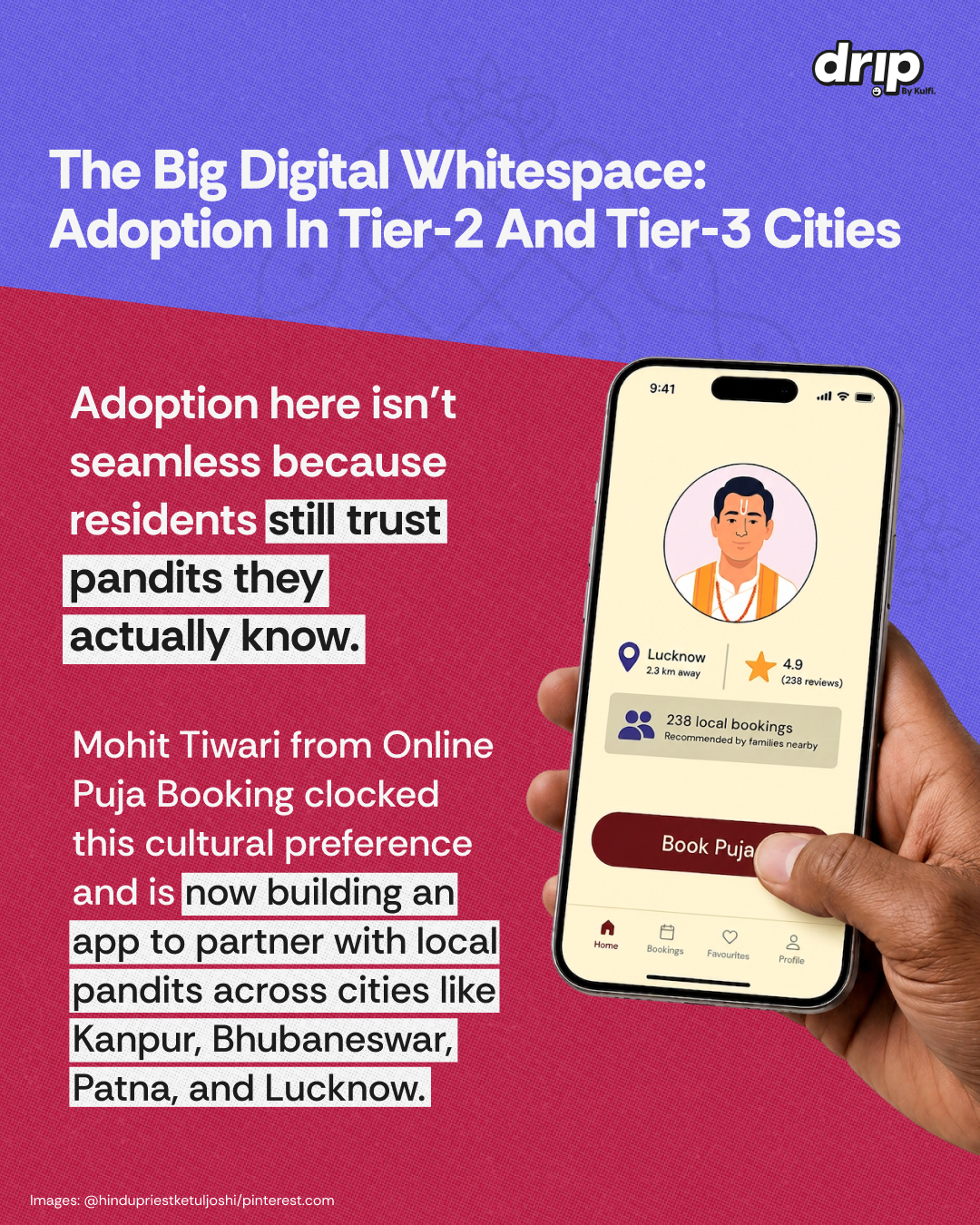
Digital adoption in tier 2 and 3 cities remains another whitespace. Residents there are more comfortable with pandits known to them. Tiwari, having understood this cultural preference, plans to launch an app to partner with local pandits in smaller towns like Kanpur, Bhubaneshwar, Patna and Lucknow. Utsav could also expand into adjacent life-event services like namakarana (naming ceremony), mundan (hair-cutting ritual) and annaprashana (to celebrate a child’s first bite of solid food). In India, rituals rarely exist in isolation, sitting inside larger ecosystems involving gifting, travel, hospitality, etc. Maybe the app could even partner with legal or financial services firms — the way wedding venues bundle photographers, florists and caterers ?. Maybe a user booking a griha pravesh (housewarming) puja also needs advice on an interior designer or a vastu consultation?
To better connect with yet another cohort like Gen Z companies could begin by speaking its language with memes, temple vlogs, astrology infographics, and updated platform UI/UX. While many young people are gravitating towards western astrology, there may be room for Vedic astrology to evolve similarly online through more accessible and shareable storytelling and digital-first experiences..
Unlike tech disruptions in other industries, India's faith-tech boom is not competing with in-person experiences, but layering on. In India, religion is not a space for surface-level trend marketing or parachute brand strategy — the most successful players will be those who understand the sociopolitical weight of religion in India and stick around long enough to earn their consumers’ trust.

